
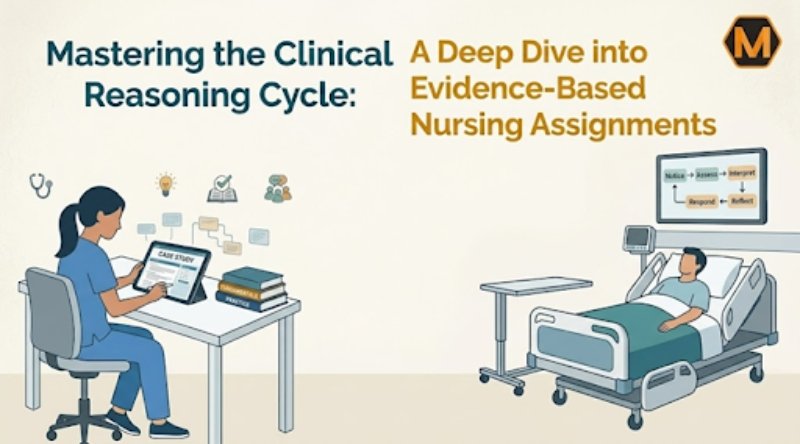
Entering the world of nursing is more than just learning how to monitor vitals or administer medication. It involves shifting your mindset from basic memorization to a sophisticated process called clinical reasoning. For undergraduate nursing students, mastering this cycle is the difference between simply completing a task and providing high-quality, safe patient care. This guide breaks down the cycle into manageable steps, helping you bridge the gap between classroom theory and real-world clinical practice.
The clinical reasoning cycle is a systematic process where nurses collect cues, process information, come to an understanding of a patient problem, plan and implement interventions, and then evaluate the outcomes. In the high-pressure environments of hospitals, this happens in seconds. However, in your university coursework, you have the luxury—and the challenge—of deconstructing this process in writing. Many students find that balancing these complex case studies with other subjects like statistics or sociology can be overwhelming. During these peak periods, it is common to look for a reliable Myassignmenthelp. My assignment help australia to help manage the workload and ensure that every academic paper meets the rigorous standards required by modern universities.
Phase 1: Consider the Patient and Collect Cues
The journey begins the moment you receive a patient handover or read a case study prompt. At this stage, you are a detective. You are looking for the “cues”—the signs, symptoms, and data points that tell a story. You must look at the patient’s current chart, their medical history, and their social context.
Collecting cues isn’t just about listing facts; it’s about recognizing what is relevant. Is a slightly elevated heart rate significant in a patient with chronic anxiety, or is it a red flag for internal bleeding? This phase requires you to apply your knowledge of anatomy and physiology to a living, breathing context.
Phase 2: Process Information and “Seeing the Big Picture”
Once you have your data, you must process it. This involves “chunking” information into patterns. You are looking for clusters of cues that point toward a specific physiological or psychological issue. During this phase, students often struggle with the sheer volume of evidence-based literature required to back up their reasoning. This is particularly true in specialized fields where the terminology is dense. If you find yourself stuck on a complex care plan, seeking out professional Myassignmenthelp Services nursing assignment writers can provide the clarity needed to structure your clinical arguments effectively, ensuring your evidence-based practice is sound and well-referenced.
Phase 3: Establish Goals and Take Action
After identifying the problem, you must decide what you want to achieve. Goals must be “SMART”: Specific, Measurable, Achievable, Relevant, and Time-bound. For example, instead of saying “the patient will feel better,” a nursing goal would be “the patient’s oxygen saturation will remain above 95% on room air for the next four hours.”
Action involves implementing the interventions you’ve planned. In an assignment, this is where you justify your choices. Why did you choose a specific position for the patient? Why is a certain medication preferred over another? You must cite the latest clinical guidelines to prove that your actions are safe and effective.
Comparison of Clinical Reasoning vs. Critical Thinking
While often used interchangeably, these two concepts have distinct roles in your nursing education:
| Feature | Critical Thinking | Clinical Reasoning |
| Definition | The broad ability to analyze and evaluate an issue. | The specific application of thinking to a patient’s clinical case. |
| Context | Can be applied to any situation (academic or personal). | Strictly happens in a clinical or simulated healthcare setting. |
| Outcome | Improved understanding and logical conclusions. | Safe patient outcomes and effective care plans. |
| Focus | How you think. | Why you act. |
Phase 4: Evaluate and Reflect
The final steps of the cycle are often the most ignored but are the most important for your growth. Evaluation asks: “Did my intervention work?” If the patient’s condition didn’t improve, the cycle starts again. You collect new cues and reassess.
Reflecting on the process allows you to identify what you did well and what you would do differently next time. In nursing assignments, the “Reflection” section is usually worth a significant portion of your grade because it demonstrates your ability to learn from experience—a core trait of a professional nurse.
Why Evidence-Based Practice (EBP) Matters
Evidence-Based Practice is the backbone of the clinical reasoning cycle. It ensures that nurses are not just doing things “the way they’ve always been done.” Instead, you are using the best available research, clinical expertise, and patient preferences to make decisions. When writing your assignments, every claim you make should be backed by a peer-reviewed journal article or a government health guideline. This builds your authority as a future healthcare professional.
Maintaining a Global Nursing Tone
Whether you are studying in Melbourne, London, or New York, the language of nursing is becoming increasingly global. A “global tone” means using standardized medical terminology while remaining culturally sensitive. It means understanding that healthcare systems vary, but the fundamental need for logical, empathetic, and evidence-based care is universal.
Final Thoughts on Academic Success
Mastering the clinical reasoning cycle takes time. It’s a skill that you will continue to refine throughout your entire career, not just during your undergraduate years. By breaking the cycle down into these specific phases, you can tackle even the most daunting case studies with confidence. Remember to stay curious, keep your research current, and don’t be afraid to ask for support when the academic pressure begins to mount.
Frequently Asked Questions (FAQ)
What is the most difficult part of the clinical reasoning cycle?
Ans: Most students find “Processing Information” the hardest because it requires you to connect theory to practice. It’s not just about knowing the facts; it’s about knowing why they matter in a specific patient scenario.
How can I improve my clinical reasoning skills?
Ans: The best way is through practice and simulation. Use your lab time to run through “what-if” scenarios. Additionally, reading case studies and practice assignments helps train your brain to spot patterns in patient cues.
Why do I need to cite so many sources in a nursing care plan?
Ans: Nursing is a science-based profession. Citing sources proves that your planned interventions are safe and have been proven effective by researchers. It protects the patient and justifies your professional judgment.
Can I use the clinical reasoning cycle for non-clinical assignments?
Ans: While specifically designed for patient care, the logical steps—collecting data, analyzing patterns, setting goals, and reflecting—are useful for any complex problem-solving task in university.
About The Author
Hi, I’m Min Seow, a Senior Academic Consultant and Lead Content Strategist at Myassignmenthelp Services. With over a decade of experience navigating the complexities of the Australian higher education landscape, my mission is to bridge the gap between rigorous university standards and student well-being. For more details, Click here